Chronicles
Liu Bei’s biggest leadership mistakes: Vision without execution
Liu Bei’s dream to restore the Han crumbled under emotion and hesitation. Discover how his tragic flaw mirrors modern leadership lessons from Nokia.

Rayden C
October 6, 2025 — 6 minutes read
Liu Bei stands as one of the most admired figures in Romance of the Three Kingdoms. He is remembered as the benevolent lord who dreamed of restoring the Han dynasty, who bound himself to brothers-in-arms like Guan Yu and Zhang Fei, and who earned the counsel of geniuses like Zhuge Liang. Yet, for all his virtue and grand vision, Liu Bei’s leadership was marked by flaws that ultimately doomed his dream.
The novel often paints him as the embodiment of righteousness, a leader guided by benevolence in an age of cruelty. But a closer reading reveals that Liu Bei’s mistakes were deeply human, born from emotion, idealism, and the inability to balance compassion with command. His greatest failure was not in dreaming too small, but in failing to translate vision into effective action.
The idealist in a ruthless age
From his earliest appearances, Liu Bei is portrayed as the moral opposite of Cao Cao. Where Cao Cao is cunning and pragmatic, Liu Bei appeals to loyalty and righteousness. This makes him beloved by both followers and the common folk, but also vulnerable.
Throughout the novel, his hesitance to act decisively often costs him dearly. He wanders from ally to ally, under Gongsun Zan, Yuan Shao, Liu Biao, never quite securing a lasting base until Zhuge Liang enters his life. Even then, it is others who push events forward: Zhuge Liang, who plans; Guan Yu and Zhang Fei, who fight; and Sun Quan, who provides the foothold in Jing Province. Liu Bei’s ideals inspired devotion, but they could not replace strategy.
In a world where strength and speed decided survival, Liu Bei’s sense of morality sometimes slowed his hand. His virtue gave him followers; his hesitation lost him ground.
The weight of personal loyalty
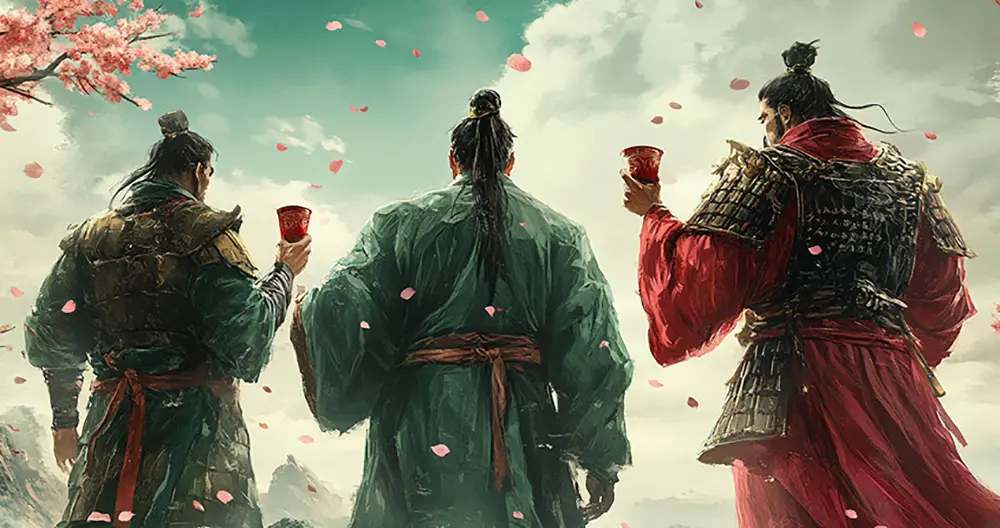
The brotherhood between Liu Bei, Guan Yu, and Zhang Fei is one of the emotional pillars of Romance of the Three Kingdoms. Sworn in the Peach Garden to live and die as one, their bond becomes both Liu Bei’s greatest strength and his deepest weakness.
When Guan Yu was slain by Sun Quan’s forces, Liu Bei’s grief consumed him. The novel shows a ruler no longer guided by Zhuge Liang’s reason, but by the pain of a brother’s death. Against all advice, he launches a campaign of vengeance that drains his army and leads to catastrophe at Yiling.
This was not the act of a calculating general; it was the act of a man. Liu Bei’s inability to separate emotion from command reveals the novel’s central tension: that even the most virtuous leader can fall when love blinds reason. His overreliance on loyalty and personal feeling becomes the spark that burns his legacy.
The tragedy of Yiling
The Yiling campaign stands as the defining moment of Liu Bei’s downfall. Despite Zhuge Liang’s counsel to make peace with Wu, Liu Bei insists on revenge. He leads his troops through narrow valleys under the summer heat, where Lu Xun’s patient defense turns to fire and fury. The army of Shu is annihilated, and Liu Bei retreats, broken in both body and spirit.

Here, Romance of the Three Kingdoms transforms him from hero to tragic figure. His ambition to restore Han ends not with conquest but with regret. Dying at Baidi Castle, Liu Bei admits his error, entrusting his son to Zhuge Liang and warning him never to repeat his mistake.
It is a powerful moment, the idealist finally confronting the price of his own emotion. The man who once moved hearts across the land learns too late that passion, unchecked, can destroy even the noblest of causes.
The limits of vision without execution
Liu Bei’s vision was grand: to revive the Han and bring peace to the realm. Yet, he never built the machinery to make it real. He had virtue, loyalty, and charisma, but he lacked the ruthless discipline that a fractured world demanded. Shu was born from his ideals, yet sustained only by others’ strength: Zhuge Liang’s intellect, Guan Yu’s valor, Zhang Fei’s fire.
The novel suggests that heaven rewards virtue, but even virtue must be paired with capability. Liu Bei’s dream died not because it was wrong, but because he could not carry it alone. His vision outpaced his command, his compassion outweighed his caution, and his legacy, though revered, is one of unfulfilled promise.
Reflections from the Romance of the Three Kingdoms
Liu Bei’s story reminds us why Romance of the Three Kingdoms endures. It is not a tale of perfect heroes, but of flawed men shaped by destiny and their own choices. His leadership teaches that morality without adaptability can be fatal, and that even the most righteous heart can falter when driven by emotion.
In the end, Liu Bei’s tragedy is not that he lost, but that he realized too late what it takes to win. His vision inspired generations, yet his downfall serves as a warning that ideals, no matter how noble, must be tempered by clear judgment and timely action. The novel leaves us with a haunting question: in a world ruled by ambition and war, can virtue alone survive?
That question still echoes today. Even beyond the pages of the novel, modern leaders have stumbled in similar ways. A striking example was Nokia, once the unshakable giant of mobile phones. It, too, had vision, connecting people across the world, and it, too, inspired fierce loyalty among employees and customers. But like Liu Bei, Nokia clung too long to its ideals, believing reputation and goodwill could carry it through a changing age. When innovation demanded bold, uncomfortable choices, it hesitated. And by the time it acted, the opportunity was gone.
Both Liu Bei and Nokia show that vision without execution is a fragile empire. Whether on the battlefield or in the boardroom, leadership demands not only dreams but the courage to adapt them before the world moves on.
Discover our recent stories


 Reflections
Cao Pi: Leading in the shadow of Cao Cao