Chronicles
Pang Tong the Young Phoenix who might have rivaled Zhuge Liang
Overshadowed by Zhuge Liang, Pang Tong's brilliance was tragically cut short. Explore how his forgotten strategic insights could have altered the course of history.

Rayden C
November 3, 2025 — 6 minutes read
The Hidden Phoenix
When Pang Tong first appears in the novel, he hardly fits the image of a brilliant strategist. Luo Guanzhong portrays him as rough in manner and with an unrefined appearance, causing people to underestimate him. In a world where courtesy, dress, and eloquence define a man’s worth, Pang Tong looks like a commoner. Introduced to Liu Bei through Xu Shu’s recommendation, Liu Bei, ever the judge of character, initially feels little impressed. This first impression is among the novel’s most ironic: the man who would help Liu Bei win an entire province is almost dismissed for looking ordinary.
But Pang Tong’s sharp mind quickly cuts through any doubts. During their first discussion, he dismantles Liu Bei’s strategic positions with surgical precision, exposing weaknesses others had overlooked. Liu Bei, humbled, realizes that he is standing before a mind as rare as Zhuge Liang’s. From that moment on, Pang Tong becomes one of Liu Bei’s closest advisers, though his personality contrasts sharply with that of the calm and elegant Zhuge Liang.
Where Zhuge Liang is composed and diplomatic, Pang Tong is impassioned and blunt. He never tempers his words to appease anyone, not even his lord. His counsel is bold, a willingness to risk everything for victory. In the story, this contrast between the two strategists becomes symbolic: the Dragon, who calculates and endures, and the Phoenix, who dares and burns.
The Three Plans to take Yi Province
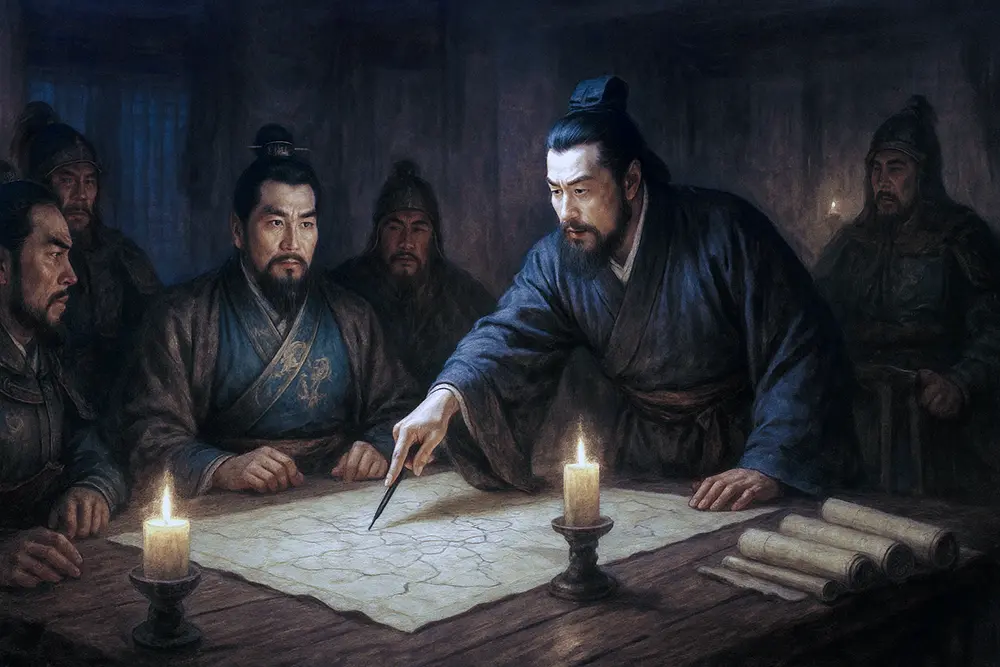
One of Pang Tong’s finest moments in Romance of the Three Kingdoms is his proposal of the “Three Plans for Yi Province.” This episode unfolds when Governor Liu Zhang invites Liu Bei to defend Yi Province against Zhang Lu. Outwardly, the mission appears friendly and supportive. Yet Luo Guanzhong infuses the situation with tension: Liu Bei’s ambitions swell, and his advisers sense that the fertile lands of Yi Province could secure his future rule.
When Liu Bei confides in his advisers, Pang Tong seizes the moment. In the novel, he lays out three options:
- The Upper Plan — launch a surprise assault on Chengdu, aiming to seize control before Liu Zhang can respond.
- The Middle Plan — capture key strategic strongholds, cutting off the capital and advancing steadily toward its heart.
- The Lower Plan — remain as Liu Zhang’s guest, continuing to wait for a more opportune moment.
Pang Tong, true to his resolute nature, urges the Upper Plan without pause. “Strike swiftly,” he insists, “before hesitation breeds disaster.” His logic is unsparing: delay invites peril. In Romance of the Three Kingdoms, such resolve often marks the boundary between victory and ruin.
However, Liu Bei hesitates; his sense of righteousness and moral image makes him reluctant to betray a host. After weighing the options, he chooses the Middle Plan, capturing strategic strongholds to gradually gain control of Yi Province. This approach balances ambition with prudence, allowing Liu Bei to advance while maintaining his moral image.
Even though Pang Tong’s preferred plan is not immediately followed, his strategic insight remains crucial. The novel credits him for providing the blueprint that allows Liu Bei to secure victories efficiently and ultimately take Chengdu. Pang Tong’s mind, though less celebrated than Zhuge Liang’s, reshapes Shu’s fate and, by extension, the balance of the Three Kingdoms.
The ambush at Luo County
Just as Pang Tong’s brilliance begins to illuminate Liu Bei’s campaign, the novel delivers one of its most tragic turns. After the success in Yi Province, Pang Tong accompanies Liu Bei on the march toward Luo County. The mission seems routine, but unbeknownst to them, enemy forces have laid a deadly ambush in the narrow valley ahead.
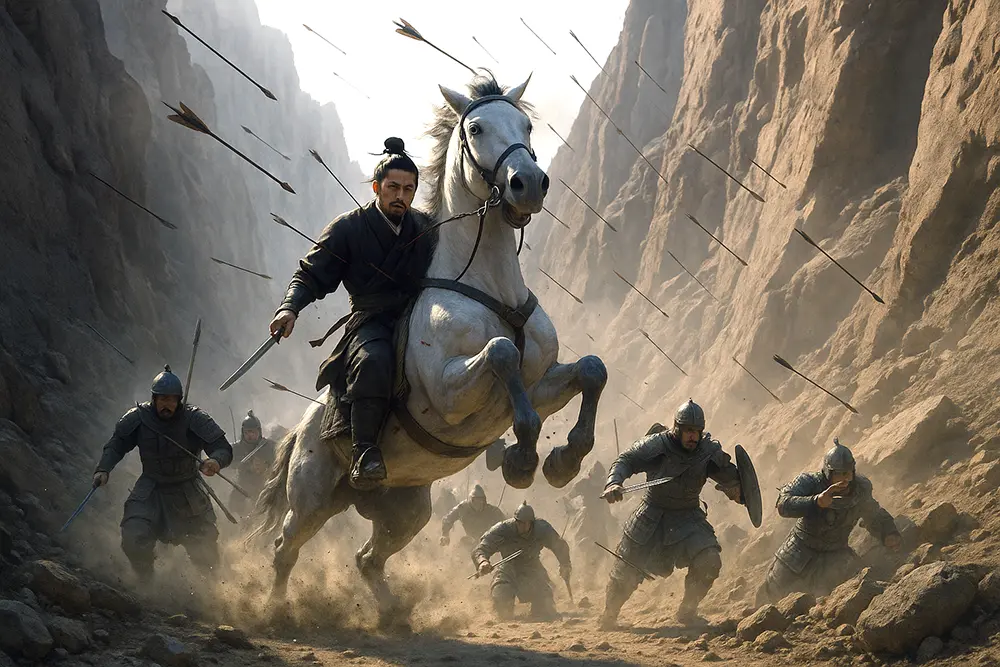
Luo Guanzhong dramatizes this episode with cinematic detail. Liu Bei and Pang Tong each lead separate routes. The enemy, misinformed about which unit carries Liu Bei, targets Pang Tong’s force instead. Riding a white horse, a striking symbol of his rank, Pang Tong becomes the focus of a rain of arrows. Chaos erupts: dust rises, soldiers cry out, and the Young Phoenix falls from his mount. His men rush to save him, but it is too late.
In the novel, his death is sudden, brutal, and deeply symbolic. The “Phoenix” destined to rise to the heavens falls before taking flight. Luo Guanzhong writes with quiet lament, stressing how heaven itself seems unjust to heroes. When Liu Bei hears of his death, he weeps bitterly, crying that Heaven is unjust to take such a man so soon. The tragedy resonates because it cuts short not just a life, but potential, the unfulfilled promise that defines many figures in the Three Kingdoms saga.
What might have been
After Pang Tong’s death, the novel subtly shifts in tone. Zhuge Liang becomes the unchallenged mind of Shu, and the story takes on a tone of patience and gradual strategy. But readers are left wondering: what if the Young Phoenix had survived?
Pang Tong’s bold, decisive approach contrasts with Zhuge Liang’s cautious, methodical planning. Together, the two could have formed a perfect duality: Pang Tong urging swift action, Zhuge Liang consolidating the gains. With both perspectives, their combined intellect might have allowed Shu to strike earlier against Wei, before the northern state grew too strong. The novel leaves this balance unresolved, inviting readers to imagine what might have been if the Phoenix had lived alongside the Dragon.
Luo Guanzhong does not dwell on Pang Tong’s afterlife, yet the echoes of his presence remain. In later chapters, Zhuge Liang occasionally laments the loss of his old friend, and even in victory, there’s an undertone of loneliness. The Dragon continues his long struggle, but the Phoenix has already fallen, a poetic balance that gives the novel its emotional depth.
A legacy of boldness
Though Romance of the Three Kingdoms immortalizes dozens of heroes, Pang Tong stands out because his brilliance is fleeting. His short-lived presence reminds readers that greatness is measured not just by longevity or number of victories, but by the impact of decisive moments. He teaches that strategy is not always about waiting for the perfect opportunity; sometimes, hesitation itself can destroy the opportunity.
In this sense, Pang Tong’s character carries a lesson beyond the battlefield. The novel portrays him as a thinker who dares to act when others hesitate, a reminder that even wisdom must sometimes burn brightly to make history move. Zhuge Liang endures as a symbol of foresight; Pang Tong, of fearless execution.
Though one became a legend and the other a memory, both are wings of the same spirit that carried Shu into the annals of destiny. And in the quiet corners of the Romance of the Three Kingdoms, where ambition and fate intertwine, the shadow of the Young Phoenix still lingers, a strategist forgotten by time, but never by those who read deeply into the story.
Discover our recent stories


 Reflections
Cao Pi: Leading in the shadow of Cao Cao