Reflections
Fa Zheng: The Strategist Liu Bei Trusted Over Zhuge Liang
Who was Fa Zheng? What the Records of the Three Kingdoms actually says about the strategist behind Liu Bei's conquest of Sichuan and Hanzhong.

Rayden C
June 13, 2026 — 6 minutes read
Fa Zheng (176–220 AD), courtesy name Xiaozhi, was the chief strategist behind Liu Bei’s two greatest victories: the taking of Yi Province (modern Sichuan) and the Hanzhong Campaign that made Liu Bei a king. According to his biography in the Records of the Three Kingdoms (Sanguozhi), he was the only official granted a posthumous title during Liu Bei’s lifetime, an honor not extended even to Guan Yu or Zhang Fei while Liu Bei lived. Yet today, almost nobody remembers his name.
Popular history casts Zhuge Liang as Shu’s guiding light: calm, wise, unshakably cautious. But before him stood another strategist with a very different reputation in the records. Where Zhuge Liang governed, Fa Zheng schemed. Where Zhuge Liang preserved, Fa Zheng gambled.
Without him, Shu might never have existed long enough for Zhuge Liang to shine.
Who Was Fa Zheng?
Fa Zheng came from Mei County in Fufeng, in the northwest, grandson of the respected scholar Fa Zhen. In the early Jian’an era (around 196), fleeing famine, he traveled into Yi Province with his fellow townsman Meng Da and entered the service of its governor, Liu Zhang.
His biography records that he waited long for recognition, was eventually made a county prefect and then a minor military adviser, and was slandered by others from his home region. Talented but sidelined, Fa Zheng spent years watching a ruler he considered incapable preside over a rich province. He was not quiet about it, either. The Sanguozhi notes he and his friend Zhang Song privately agreed that Liu Zhang was not a lord worth accomplishing anything with.
That frustration became history’s pivot point.
Persuading Liu Bei to Seize Sichuan
When Liu Zhang decided to ally with Liu Bei, Fa Zheng was sent as his envoy. He returned officially praising the alliance, and privately convinced that he had found the master worth serving. He and Zhang Song began to plot.
Their chance came when Liu Zhang invited Liu Bei into Yi Province to campaign against Zhang Lu in the north. Carrying the invitation, Fa Zheng delivered a second, secret message of his own: take the province itself. His biography records his argument. With Fa Zheng and Zhang Song as inside men and Yi Province’s resources as a foundation, Liu Bei could finally stop wandering and build something permanent.
It was a dangerous proposition. Liu Bei would be turning on the man who welcomed him. But Fa Zheng read the situation correctly at every step. When war broke out and one of Liu Zhang’s advisers proposed a scorched-earth retreat that would have starved Liu Bei’s army, Fa Zheng predicted Liu Zhang would never accept a plan that harmed his own people to repel an enemy. He was right. By 214, Chengdu had surrendered, with Fa Zheng having personally written to Liu Zhang urging him to yield.
The wanderer finally had a kingdom, because one overlooked advisor decided his talents deserved a better master.
The Hanzhong Campaign and Mount Dingjun
If Sichuan proved Fa Zheng’s judgment, Hanzhong proved his eye for the battlefield.
In 217, it was Fa Zheng who proposed the campaign. His biography preserves the reasoning: Cao Cao had subdued Hanzhong but, instead of pressing into Yi Province, had returned north, leaving Xiahou Yuan and Zhang He to hold it. To Fa Zheng, this signaled trouble elsewhere in Cao Cao’s realm, and an opening that would not last. Liu Bei agreed and marched.
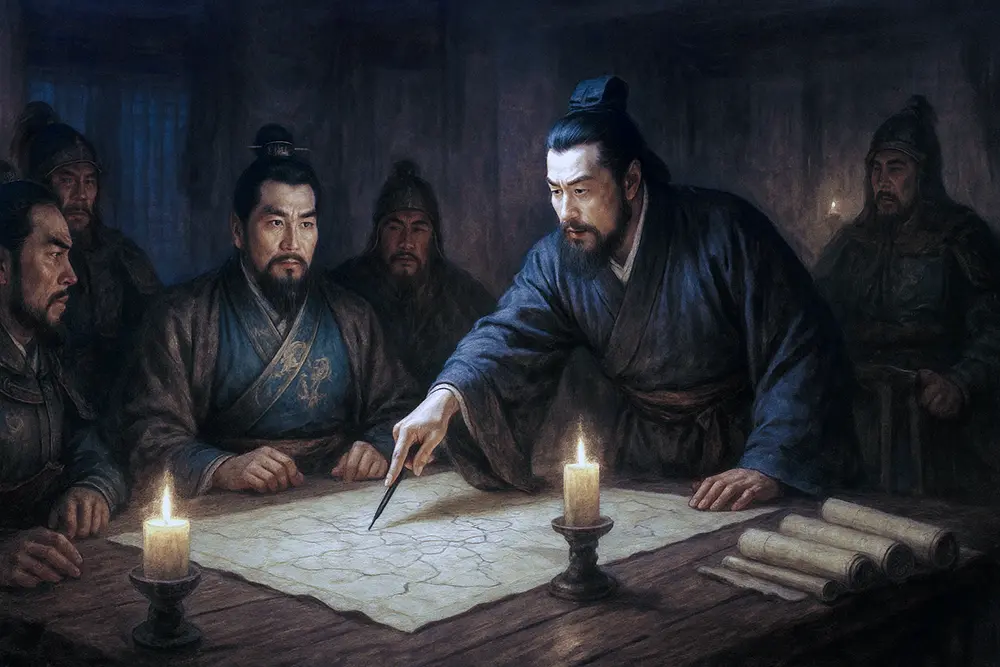
The decisive moment came in 219 at Mount Dingjun. Liu Bei’s army had crossed the Mian River and camped on the mountain; Xiahou Yuan came to contest the position. The Sanguozhi records the moment plainly: Fa Zheng said the enemy could now be struck. Liu Bei ordered the veteran general Huang Zhong forward, drums thundering, attacking from above. Xiahou Yuan, Cao Cao’s commanding general in the region, was killed. It was one of the most shocking deaths of a senior commander in the entire period.
Fa Zheng’s biography also records Cao Cao’s reaction on learning who was behind the campaign: that he had always known Liu Bei was incapable of this on his own, and must have been taught.
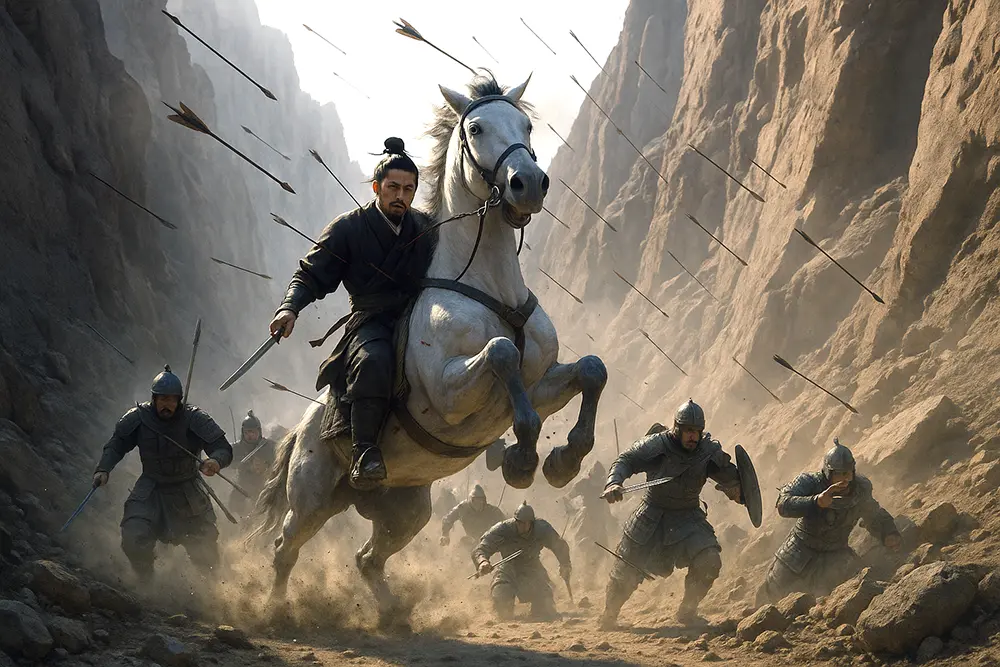
One more story survives from this campaign, preserved in Pei Songzhi’s annotations. In a battle that turned against them, with arrows falling thickly, Liu Bei refused to retreat and no one dared press him. Fa Zheng simply walked forward and placed himself in front of his lord. When Liu Bei shouted at him to avoid the arrows, Fa Zheng answered that if his lord stood under arrows and stones, how could he not? Liu Bei withdrew. For him.
When Cao Cao himself arrived with reinforcements, Liu Bei held his ground until Cao Cao withdrew. The triumph made Liu Bei King of Hanzhong, the symbolic high point of his life. Fa Zheng was named Prefect of the Masters of Writing, head of the royal secretariat.
Fa Zheng vs Zhuge Liang
The two men’s roles were defined by the court itself. Liu Bei’s biography in the Sanguozhi describes the division at the height of his rise: Zhuge Liang as his “trunk and limbs,” the pillar of governance, and Fa Zheng as his chief of stratagem. One ran the state; the other planned the wars. The records also note that despite very different temperaments, the two respected each other on matters of public duty.
But the most powerful evidence of Fa Zheng’s standing came after his death, from Zhuge Liang’s own mouth.
In 222, against widespread objection, Liu Bei marched east against Wu and was catastrophically defeated at Yiling. Fa Zheng’s biography records Zhuge Liang’s lament: had Fa Xiaozhi been alive, he could have restrained their lord from marching east at all. And even had the march happened, it would not have ended in such ruin.
Sit with what that sentence admits. Zhuge Liang, chancellor, legend, the man history remembers as Liu Bei’s other half, conceded that he could not stop his lord, and that Fa Zheng could have. No other line in the records measures Fa Zheng’s influence so precisely.
The Silence After His Death
Fa Zheng died in 220, the year after the Hanzhong triumph, at forty-five by traditional count. His biography records that Liu Bei wept for days. He was granted the posthumous title Marquis Yi, and the Sanguozhi notes he was the only person to receive a posthumous title in Liu Bei’s time. Not Guan Yu. Not Zhang Fei. Fa Zheng.
For Shu, the loss was more than grief. Two years later at Yiling, the kingdom discovered exactly what it had lost: the one voice that could overrule its emperor.
Why Fa Zheng Still Matters
Fa Zheng will never rival Zhuge Liang in fame. The novel gave him no immortal scenes; opera gave him no mask. But the dry, careful pages of the Sanguozhi preserve something arguably more interesting than legend: a vindictive, brilliant, indispensable man whose gambles created the stage on which Zhuge Liang would later play.
He reminds us that the making of history is messy. Kingdoms are not just maintained by wisdom but seized through risk, ruthlessness, and timing.
Discover our recent stories


 Reflections
Cao Pi: Leading in the shadow of Cao Cao