Chronicles
Zhang Liao: Hero of Hefei
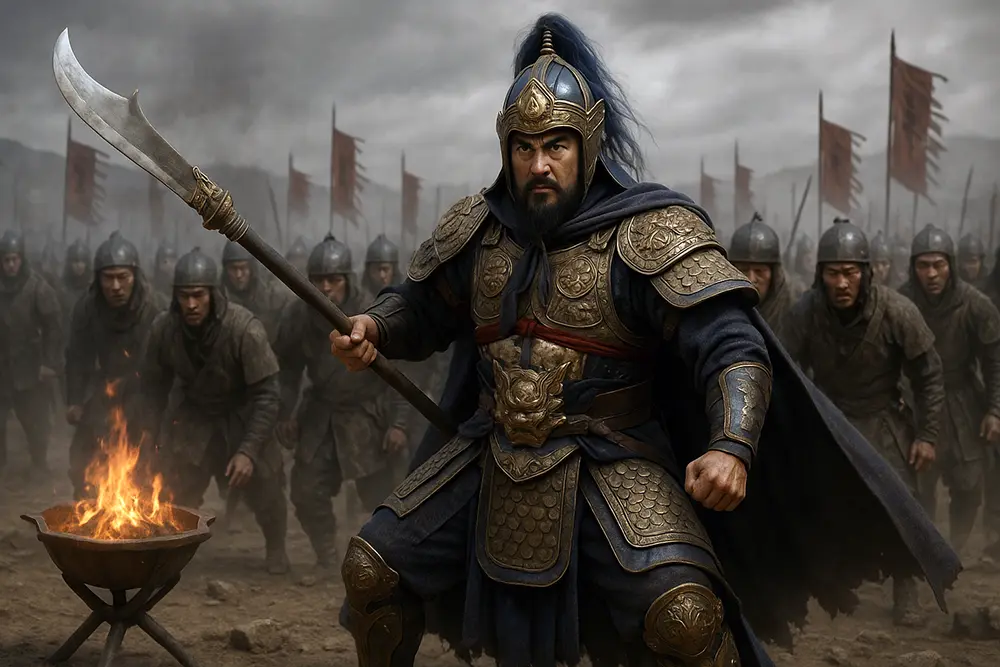
At the Battle of Hefei, Zhang Liao led a daring dawn charge with a few hundred men, stunning Sun Quan’s larger army and earning his place as the Hero of Hefei.

Rayden C
September 1, 2025 — 7 minutes read
In the annals of the Three Kingdoms, few defensive stands rival the Battle of Hefei. It was here, in 208 CE, that Zhang Liao, a general under Cao Cao, faced an invasion from Sun Quan’s Wu. Outnumbered and isolated, he transformed a desperate situation into one of the most celebrated feats of courage in the era. To this day, he is remembered as the “Hero of Hefei.”
A fortress between two worlds
The Battle of Red Cliffs had shaken the balance of power. Cao Cao’s bid to unify the empire had collapsed in fire and disease along the Yangtze, leaving Wu and Shu triumphant in the south. But Cao Cao was far from finished. The north remained his stronghold, and he still commanded vast armies.
Hefei was one of the keys to this balance. Situated along the Huai River, it stood as a gateway between the northern heartlands of Wei and the southern territories of Wu. Whoever held Hefei could strike across the borderlands or block invasions from the other side. For Sun Quan, it was the logical next step after Red Cliffs: seize Hefei, and the road to the north would open.
Cao Cao anticipated the threat. But he had greater campaigns to manage and could not remain in the south. He entrusted Hefei to a handful of generals, among them Zhang Liao, a man already known for his bravery, but about to earn a reputation that would eclipse all others.
Zhang Liao: The warrior’s general
Zhang Liao was not born into the high aristocracy. He had served multiple masters before joining Cao Cao, gaining experience as both a fighter and a commander. Tall, broad-shouldered, and commanding, he was the kind of leader who fought at the front lines rather than from behind a desk.
His men adored him because he shared their hardships. He was known for entering the thick of battle with his soldiers, rallying them not through orders alone but by example. That bond would prove decisive at Hefei, where morale mattered more than numbers.
Facing the storm
When word came that Sun Quan himself was marching north, the situation looked dire. Wu’s army was massive, dwarfing the small garrison left at Hefei. Panic might easily have taken hold, but Zhang Liao refused to let fear rule.
He assessed the situation with calm clarity. If his troops huddled behind the walls, Wu would surround them, choke off supplies, and grind the defenders down. But if he struck first, boldly and unexpectedly, he could disrupt the siege before it began.
It was a gamble. He had perhaps 800 men ready to ride with him, against an enemy numbering in the tens of thousands. Yet Zhang Liao understood that in war, psychology could be as powerful as steel.
The dawn charge
At first light, Zhang Liao gathered his chosen soldiers. Accounts say he spoke to them not as expendable pawns, but as comrades: “We are few, they are many. But if we strike first, their numbers will mean nothing. If you follow me, we will carve fear into their hearts.”
With banners flying and drums beating, he rode out of Hefei and plunged straight into Sun Quan’s camp.
The effect was electric. Wu’s soldiers, expecting to face a demoralized garrison, were stunned by the ferocity of the assault. Zhang Liao cut down foes with his halberd, rallying his men with every strike. His charge drove deep into the camp, scattering soldiers who barely had time to form ranks.
The chaos rippled outward. Rumors spread that Zhang Liao’s entire army was upon them, that Cao Cao’s forces had arrived, that the defenders of Hefei were far stronger than expected. Sun Quan himself was nearly caught in the melee, forced to flee for his life, narrowly escaping capture or death.
By the time Zhang Liao withdrew back into Hefei, the tide of the campaign had shifted. The defenders had won no great slaughter, but they had won something more important: morale.
Turning fear into a weapon
Wu still outnumbered the defenders, but the psychological balance had flipped. Sun Quan’s generals, shaken by the audacity of the attack, hesitated. If Zhang Liao could charge into their camp once, what else might he do?
Inside Hefei, Zhang Liao’s men were transformed. What had seemed a hopeless defense now felt like destiny. Their general had led them into the jaws of the enemy and brought them back alive, bloodied but victorious. If he could do that, they reasoned, then Hefei could hold.
This was Zhang Liao’s true genius: not just the charge itself, but the way he wielded fear and courage as weapons. He taught his men that numbers meant nothing if spirit was strong, and he taught his enemies that victory was not guaranteed even with overwhelming force.
The long siege
The battle did not end in a single day. Wu regrouped and pressed the siege, but the momentum had been broken. Each assault met fierce resistance. Zhang Liao organized defenses, rotated his men to preserve stamina, and launched sudden sallies to harass the besiegers.
The defenders held out until Cao Cao’s reinforcements approached. Faced with the prospect of being caught between a fresh Wei army and Zhang Liao’s garrison, Sun Quan withdrew. Hefei remained in Wei’s hands and Zhang Liao’s reputation soared.
Boldness as strategy
Historians and storytellers alike have marveled at Hefei because it illustrates a paradox: that sometimes the best defense is attack. Zhang Liao’s dawn charge was not reckless bravado but calculated strategy.
- By attacking first, he denied Wu the chance to dictate the terms of battle.
- By choosing a small, handpicked force, he ensured cohesion and loyalty.
- By striking at dawn, he maximized confusion and minimized preparation time.
- By withdrawing quickly, he preserved his men while leaving a lasting shock in the enemy’s mind.
It was an economy of force that magnified his small numbers into a decisive impact.
A reputation even enemies respected
What makes Zhang Liao’s feat at Hefei stand out is the respect it earned from both sides. Sun Quan himself reportedly praised him, acknowledging that Hefei could not be taken so long as Zhang Liao stood within its walls. For a ruler to honor his enemy in this way speaks volumes about the impression Zhang Liao left.
Within Wei, he became a symbol of loyalty and courage, one of the commanders Cao Cao could trust implicitly. His name became synonymous with discipline and daring, a rare combination in an age where generals often leaned too heavily toward one or the other.
Why Hefei still matters
The stand at Hefei is more than a thrilling tale of a cavalry charge. It is a lesson in the power of leadership under pressure. Zhang Liao showed that strategy is not only about numbers, maps, or resources, it is about timing, morale, and the will to act decisively when others hesitate.
In many ways, Hefei was Zhang Liao’s masterpiece. Other generals are remembered for conquest or great victories, but he is remembered for holding a line that should have broken, and for turning desperation into triumph.
Even today, his name carries the aura of a man who understood that courage without calculation is recklessness, and calculation without courage is paralysis. At Hefei, Zhang Liao fused the two into legend.
Discover our recent stories


 Reflections
Cao Pi: Leading in the shadow of Cao Cao